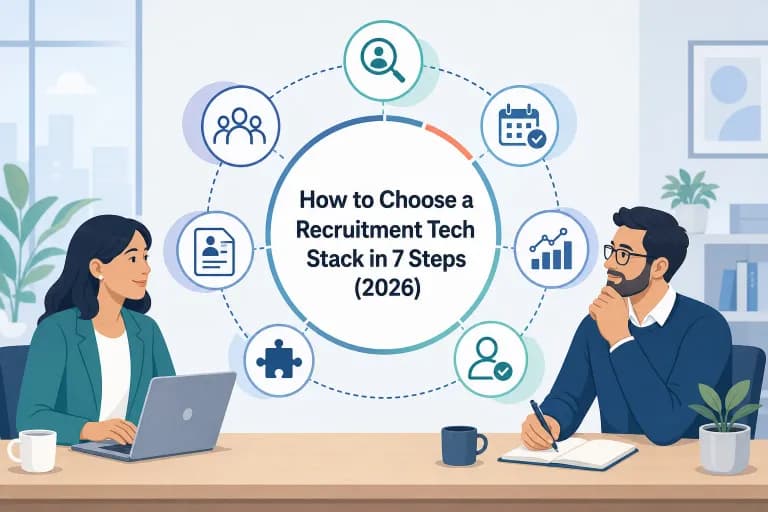
How to Choose a Recruitment Tech Stack in 7 Steps (2026)
Choosing the right technology before you launch your recruitment agency is one of the most important decisions you will make as a founder.
Choosing the right technology before you launch your recruitment agency is one of the most important decisions you will make as a founder. Get it wrong, and you will spend your first months fixing systems instead of billing. Get it right, and your operations run from day one.
This guide walks you through seven clear steps for building a recruiting tech stack that covers CRM, compliance, payroll, and marketing. SSG Recruitment Partnerships equips recruitment entrepreneurs with ready-to-use systems and back-office infrastructure so you can focus on winning business rather than configuring software.
By the end, you will know exactly which tools to evaluate, how they connect, and where to invest your time before launch day.
Quick Guide: How to Choose a Recruitment Tech Stack in 7 Easy Steps
- Map your recruitment workflow: Outline every stage from sourcing candidates to placing and invoicing.
- Identify your compliance requirements: List the regulatory obligations your agency must meet from day one.
- Choose a recruitment CRM or ATS: Pick a candidate and client management platform that fits your sector.
- Set up your payroll and accounting systems: SSG Recruitment Partnerships includes payroll and accounting tools for partners from launch.
- Select communication and collaboration tools: Decide on telephony, email, and video platforms for daily operations.
- Plan your marketing and branding technology: Choose tools for your website, social media, and candidate attraction.
- Test integrations before you go live: Run end-to-end checks to confirm every system talks to the others.
How to Build Your Recruitment Tech Stack Before Launch Day
1. Map your recruitment workflow
Before you compare any platforms, write down every step in your recruitment process. Start with how you plan to source candidates and end with how you will invoice your clients. Include interim steps like screening, interviewing, compliance checks, and onboarding.
This exercise reveals which categories of technology you actually need. A permanent placement agency has different workflow requirements than a contractor or temporary staffing desk.
Sketch the workflow on paper or in a simple spreadsheet. Mark where manual tasks will slow you down, because those are the areas where technology saves the most time. If you are starting a recruitment agency for the first time, this mapping step prevents expensive tool changes later.
2. Identify your compliance requirements
Recruitment agencies in the UK must meet specific regulatory obligations before placing a single candidate. These include GDPR data handling, right-to-work checks, and (for agencies placing contractors) IR35 status determination, CIS registration, and RTI submissions to HMRC.
Your tech stack needs to support these requirements from launch. That means your CRM must store consent records, your payroll system must handle PAYE, and your document management must track candidate verification files.
List every compliance obligation relevant to your sector and placement type. Then confirm each system you are considering can meet it. According to HR.com's Future of Recruitment Technologies 2025-26 report, compliance automation is now a top priority for recruitment firms of all sizes. If compliance is new to you, review our guide on legal and accounting red flags for recruiters.
3. Choose a recruitment CRM or ATS
Your CRM or applicant tracking system is the central hub of your recruitment business. It stores candidate profiles, tracks client relationships, manages job orders, and records every interaction across the placement lifecycle.
When evaluating options, focus on three criteria: how the platform handles candidate search and filtering, whether it supports the placement types you offer (permanent, contract, or temporary), and how easily it connects to your other systems.
Popular CRM platforms in the UK recruitment market include options built specifically for agencies. SSG Recruitment Partnerships includes a recruitment CRM as part of its technology package, configured and supported from day one. This removes the setup burden and lets you start tracking candidates and clients immediately.
4. Set up your payroll and accounting systems
Payroll and accounting are where many new recruitment founders lose time. If you are placing contractors or temporary workers, you need a payroll system that handles weekly pay runs, holiday pay calculations, pension auto-enrolment, and HMRC submissions.
On the accounting side, you need invoicing, expense tracking, bank reconciliation, and VAT returns. Cloud-based accounting platforms like Xero integrate with most recruitment CRMs, giving you a single view of your financial position.
SSG Recruitment Partnerships handles accounting and payroll for its partners through a specialist team. This means your bookkeeping, Corporation Tax, PAYE, and monthly management accounts are taken care of so you can concentrate on billing. That level of back-office support is difficult to replicate if you are setting up everything independently.
5. Select communication and collaboration tools
You will spend most of your working day talking to candidates and clients. Your communication tools need to be reliable, professional, and easy to access from wherever you work.
At a minimum, you need a business email platform, a VoIP or cloud telephony system, and a video conferencing tool. Microsoft Teams or similar platforms combine messaging, calls, and video in one place, which simplifies your day-to-day operations.
Consider how your communication tools integrate with your CRM. Logging calls and emails against candidate and client records automatically saves manual data entry. Many recruitment agencies also add LinkedIn Recruiter to their stack for sourcing, which is a separate licence to budget for.
6. Plan your marketing and branding technology
Your brand and online presence need to be live before your first business development call. That means you need a professional website, a company email domain, social media profiles, and the ability to post job adverts across relevant boards.
Choose a website platform that lets you update content quickly without needing a developer. Your job board access will depend on your sector and budget. Some recruitment partnerships offer preferential rates on recruitment technology and job board access through collective buying power.
If you are launching as a solo recruiter, SSG Recruitment Partnerships assigns a Creative and Technical team to build your brand identity, website, and marketing materials before you go live. That investment covers logo design, pitch decks, and LinkedIn campaign setup.
7. Test integrations before you go live
Once you have selected your tools, run a full end-to-end test before your launch date. Create a dummy candidate record in your CRM, push it through every workflow stage, generate a test invoice, and confirm the data lands correctly in your accounting system.
Check that your email and telephony platforms log interactions against the right records. Test your website forms to make sure candidate applications reach your ATS. Run a sample payroll cycle if you plan to place contractors.
This testing phase catches configuration errors before they affect real placements. If you are working with a technology partner, ask them to run the test alongside you. At SSG Recruitment Partnerships, the Systems and Technology team handles this configuration and testing as part of the launch process.
What Technology Do New Recruitment Agencies Need Most?
New recruitment agencies need a CRM or ATS, a payroll system (if placing contractors or temps), an accounting platform, communication tools, and a professional website. These five categories cover the minimum requirements for billing and compliance.
The specific tools you choose depend on your placement types and sector. An agency focused on permanent placements has simpler payroll needs than one running a temporary staffing desk with weekly pay runs and HMRC submissions.
Many founders also add LinkedIn Recruiter licences and job board subscriptions to their stack early. Prioritise the tools that directly support revenue generation and regulatory compliance, and add extras once you are billing consistently.
How Does a Recruitment CRM Differ From a Standard CRM?
A recruitment CRM is designed specifically for managing candidates, clients, and job orders across the placement lifecycle. Standard CRMs track sales pipelines and customer relationships, but they lack recruitment-specific features like CV parsing, candidate search filters, and compliance document tracking.
Recruitment CRMs also handle placement workflows, including job matching, interview scheduling, and offer management. Many include built-in integrations with job boards and LinkedIn, which a general-purpose CRM does not offer.
If you are launching a recruitment agency, a specialist platform saves you from building workarounds and manual processes. SSG Recruitment Partnerships includes a recruitment-specific CRM as part of its launch package, so you do not need to evaluate, purchase, or configure one independently.
How SSG Recruitment Partnerships Helps You Build Your Tech Stack
Selecting, purchasing, and configuring a full recruitment technology stack is one of the most time-consuming parts of launching an agency. SSG Recruitment Partnerships removes that burden entirely for its partners.
When you partner with SSG, you receive a complete technology package from day one. This includes a recruitment CRM, cloud-based accounting through Xero, VoIP telephony, Microsoft Office 365, online timesheets, and LinkedIn Recruiter access. Every system is configured by our specialist team and supported on an ongoing basis.
SSG invests significantly in your business during the first three months, offering systems and services free of charge while you get up and running. Your designated Account Manager works with you to confirm each system fits your workflow, and Partner Support is available whenever you need guidance.
Let us help you build a strong operational foundation. Explore our launch guide or calculate your earnings potential to see what your recruitment business could look like with the right infrastructure behind it.
FAQs About Choosing a Recruitment Tech Stack
Do I need a recruitment CRM before I launch?
Yes. A recruitment CRM stores your candidate and client data from your very first interaction. SSG Recruitment Partnerships includes a configured CRM in its launch package, so you are operational from day one without sourcing or setting up the platform yourself.
How much should I budget for recruitment technology?
Costs vary depending on which platforms you select and how many licences you need. SSG Recruitment Partnerships invests in your technology during the initial launch phase, covering CRM, telephony, and accounting systems. Check the SSG Recruitment Partnerships website for current details on what is included.
Can I change my tech stack after launch?
You can, but switching systems mid-operation means migrating data and retraining. Choosing the right platforms before launch reduces the risk of costly changes later. Test your workflow end-to-end during setup to confirm everything fits.
What compliance tools do UK recruitment agencies need?
UK recruitment agencies need tools that support GDPR consent tracking, right-to-work document storage, and (for contractor placements) IR35 assessment, CIS registration, and RTI payroll submissions. SSG Recruitment Partnerships handles compliance-related accounting and payroll processes for its partners.
Should I buy tools individually or use a bundled platform?
Bundled platforms reduce integration complexity and often come with dedicated support. Individual tools offer more flexibility but require you to manage connections between systems yourself. For recruitment entrepreneurs launching their first agency, a bundled approach typically gets you billing faster.

-768x512.webp&w=3840&q=75)
-768x512.webp&w=3840&q=75)