How to Audit a Recruitment Agency Launch Plan in 7 Steps (2026)
Launching your own recruitment agency is one of the most rewarding moves you can make as an experienced recruiter. It is also one of the most operationally complex.
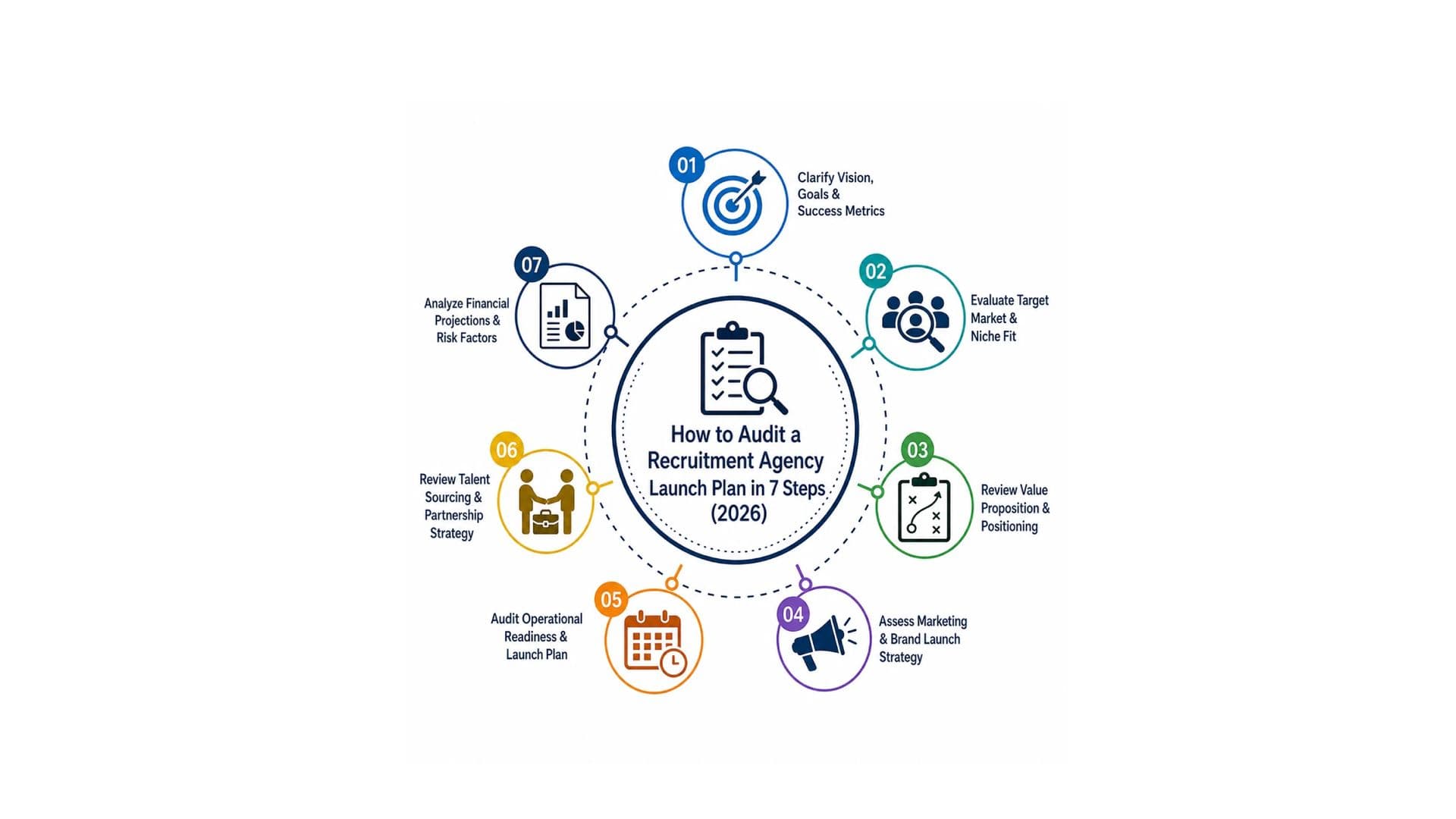
Launching your own recruitment agency is one of the most rewarding moves you can make as an experienced recruiter. It is also one of the most operationally complex.
From company registration and HMRC obligations to contract templates and data protection, a long list of requirements sits between your decision to go independent and your first placement.
That's why a structured pre-launch audit matters. SSG Recruitment Partnerships supports recruitment entrepreneurs through every stage of recruitment startup support, and this guide walks you through the specific checks you should complete before going live. Follow these seven steps to identify gaps, reduce risk, and give yourself the strongest possible start.
Quick Guide: How to Audit a Recruitment Agency Launch Plan in 7 Easy Steps
- Map your legal and compliance obligations — Confirm company registration, data protection, and employment law requirements.
- Review your accounting and tax setup — Verify PAYE, VAT registration, and bookkeeping processes are in place.
- Audit your cash flow and funding plan — Stress-test your finances for the first three to six months of trading.
- Assess your technology and systems readiness — Check that your CRM, VoIP, and job board access are configured. SSG Recruitment Partnerships sets up your full tech stack before you go live.
- Evaluate your brand and marketing foundations — Confirm your website, logo, pitch decks, and LinkedIn presence are launch-ready.
- Check your operational support structure — Identify which back-office functions you will handle and which you will outsource.
- Stress-test your first 90-day billing plan — Model realistic revenue scenarios against your fixed costs and pipeline.
How to Audit Your Recruitment Agency Launch Plan Before Going Live
1. Map your legal and compliance obligations
Before you take a single client call, confirm that your legal foundations are solid. This means verifying your company registration at Companies House, your certificate of incorporation, Data Protection Registration with the ICO, and your terms of business for both clients and candidates.
UK recruitment agencies must comply with the Employment Agencies Act 1973, the Conduct of Employment Agencies and Employment Businesses Regulations 2003, GDPR, and IR35 legislation. Each of these carries specific obligations around contract wording, data handling, and worker status assessments.
Audit your contracts line by line. Check that your client terms of business include fee structures, rebate clauses, and payment terms. Candidate agreements should cover data consent, right-to-work checks, and how you will act (as an agency or employment business).
If you plan to place temporary workers, you also need to account for the Agency Workers Regulations 2010.
Missing even one of these steps can result in fines or disputed invoices. Create a compliance register that lists every obligation, the responsible party, and the completion date.
2. Review your accounting and tax setup
Your accounting infrastructure needs to be fully operational before you start billing. This includes PAYE registration, VAT registration (if applicable), Corporation Tax setup, and Government Gateway access for HMRC submissions.
Recruitment accounting carries specific complexities. If you place contractors, you need to manage CIS deductions, RTI submissions, and potentially reverse-charge VAT. Your bookkeeping system should handle invoicing, expense tracking, and monthly management accounts so you can see your true financial position at any point.
Walk through your accounting and payroll workflow from invoice creation to cash receipt. Confirm that your software (many recruitment agencies use platforms like Xero paired with HubDoc for document capture) is correctly integrated and that someone qualified is reviewing the numbers each month.
If your tax and payroll processes have gaps, the consequences show up fast. Late PAYE submissions attract penalties from HMRC, and VAT errors can create cash flow problems that take months to resolve.
3. Audit your cash flow and funding plan
Cash flow is the single biggest risk for new recruitment agencies. You will often pay contractors or cover your own costs weeks before client invoices are settled. If your funding plan does not account for this gap, your agency could face liquidity problems before you ever build momentum.
Build a detailed cash flow model covering at least six months. Include your expected placement fees, payment terms (typically 30 to 60 days), fixed overheads, and personal drawings. Then stress-test that model: what happens if your first placement takes 90 days instead of 60? What if a client pays late?
Identify your funding sources. Options include personal savings, a business loan, invoice factoring, or a partnership model where an operational partner funds your launch. Whichever route you choose, make sure you have enough capital to cover at least three months of zero revenue.
Review your credit control process as well. Decide how you will chase overdue invoices, what payment terms you will set, and at what point you will escalate. Many first-time founders underestimate how much time chasing payments consumes if there is no clear process in place.
4. Assess your technology and systems readiness
Your recruitment technology stack directly affects how quickly you can start billing. At a minimum, you need a CRM or applicant tracking system (ATS), a VoIP phone system, email and calendar tools, job board access, and LinkedIn Recruiter.
Audit each system for three things: is it configured correctly, is it integrated with your other tools, and do you know how to use it? A CRM that is not set up with your pipeline stages, email templates, and reporting dashboards will slow you down from day one.
Check your data migration plan as well. If you are moving from an employer's system, confirm that you have the right to take candidate and client data with you. GDPR imposes strict rules on data portability, and violating them could create legal exposure before you even launch.
If setting up and managing a technology stack is not your strength, that is a clear signal to outsource this function to a specialist who understands recruitment workflows.
5. Evaluate your brand and marketing foundations
Your brand is not just a logo. It is the first impression you make on every client and candidate who encounters your agency.
Before launch, confirm that your website is live and professionally designed, your logo and visual identity are consistent across all materials, and your LinkedIn company page is set up and populated.
Review your pitch deck and make sure it clearly communicates your niche, your value proposition, and the types of roles you fill. If you are positioning yourself as a specialist recruiter, your marketing materials should reflect that specialism in language, case studies, and sector knowledge.
Audit your LinkedIn profile as well. For most recruitment entrepreneurs, LinkedIn is the primary business development channel. Your personal profile should clearly state your new venture, your target market, and how prospects can contact you.
If you do not have in-house marketing capability, consider working with a recruitment-focused creative team that understands the nuances of positioning an agency in a competitive market.
6. Check your operational support structure
Running a recruitment agency involves far more than placing candidates. You need to manage payroll, invoicing, credit control, HR policies, contracts, and compliance on an ongoing basis. Before launch, map every back-office function and decide how each will be handled.
For each function, ask three questions: who will do this, what tools will they use, and what happens if it goes wrong? If the answer to "who" is "me" for every function, that is a risk. Time spent on administration is time not spent on business development and billing.
Many recruitment entrepreneurs choose to outsource back-office operations to a strategic partner who specialises in recruitment businesses. This converts fixed costs into variable costs and gives you access to specialist expertise in areas like payroll, credit control, and legal compliance from day one.
Document your operational plan clearly. List every function, the responsible party, the frequency (daily, weekly, monthly), and the tools involved. This document becomes your operational audit trail as your agency grows.
7. Stress-test your first 90-day billing plan
Your 90-day plan is the bridge between launching and generating sustainable revenue. It should include your target number of client meetings, job briefs, candidate submissions, and placements, broken down by week.
Be specific and honest. If you know your average time to fill a permanent role is six to eight weeks, do not assume placements in week two. Build your plan around realistic conversion rates from your previous experience and adjust for the fact that you are building pipeline from scratch.
Include non-billing targets as well: the number of LinkedIn connections you want to make, the marketing activities you will run, and the referral conversations you will have. These activity metrics are leading indicators that give you early warning if your pipeline is not building fast enough.
Review your plan against your cash flow model from step three. If your projected billing timeline extends beyond your funding runway, you need to either extend your capital or accelerate your go-to-market activity. The time to discover this gap is before launch, not three months in.
According to data from the Insolvency Service, young businesses in the staffing sector face elevated insolvency rates in their first two years. This reinforces why pressure-testing your financial plan before going live is a critical step.
What legal requirements do UK recruitment agencies need before launch?
UK recruitment agencies must register with Companies House, register for PAYE and Corporation Tax with HMRC, and complete Data Protection Registration with the ICO. If you place temporary workers, you may also need to register with the Gangmasters and Labour Abuse Authority (GLAA) depending on your sector.
Beyond registration, you need compliant terms of business for both clients and candidates. These contracts must meet the requirements of the Employment Agencies Act 1973 and the Conduct Regulations 2003.
They should clearly state how you are acting (as an agency or employment business), your fee structures, and your data handling practices under GDPR.
Many recruitment entrepreneurs underestimate the time required to get these documents right. Having contracts reviewed by a specialist who understands recruitment-specific regulations is one of the most effective risk reduction steps you can take before going live.
How much funding do first-time recruitment founders typically need?
The amount depends on your business model. If you are placing permanent candidates and working from home, your fixed overheads may be relatively low. You still need to cover personal living costs during the period before your first fee lands.
Most recruitment entrepreneurs should budget for at least three to six months of expenses with no revenue.
Costs to account for include company formation fees, professional indemnity insurance, recruitment software subscriptions, job board access, marketing materials, accounting fees, and your own personal drawings. For temporary staffing models, you also need to factor in contractor pay before client invoices are settled, which significantly increases your working capital requirement.
Some founders self-fund from savings. Others explore business loans, invoice factoring, or partnership models where the operational partner invests in the business from day one. SSG Recruitment Partnerships, for example, invests in recruitment entrepreneurs during the early stage, covering systems, services, and launch infrastructure so founders can focus on building pipeline.
Whichever route you take, the key is to confirm your funding before you hand in your notice, not after.
How SSG Recruitment Partnerships helps you audit and launch your recruitment agency
Auditing a launch plan is complex. Legal obligations, accounting setup, cash flow modelling, technology configuration, branding, and operational planning each require specialist knowledge that most experienced recruiters have not needed until now. That's why SSG Recruitment Partnerships exists.
As the market-leader in supporting and investing in recruitment businesses, SSG handles the operational infrastructure that sits around your core recruiting activity. That means your company registration, contract templates, PAYE and VAT setup, CRM configuration, brand design, website build, and credit control processes are all in place before you take your first call.
SSG invests in your business during the first three months, covering technology, systems, and services so you can focus on what matters: winning business and finding top talent for your clients.
Your designated Partner Support Manager works with you on growth plans and strategic advice from day one. The MY SSG community connects you with a network of recruitment entrepreneurs who have navigated the same journey.
If you are ready to launch your own recruitment business with a structured, audit-ready foundation, let us help you build something that lasts. Book a call with the SSG team and find out how we can support your launch.
FAQs About How to Audit a Recruitment Agency Launch Plan
How long does a full pre-launch audit take?
A thorough audit typically takes two to four weeks, depending on how much of your legal, financial, and operational setup is already in place. If you are starting from scratch, allow extra time for company registration, contract drafting, and technology setup.
Can I audit my launch plan without professional help?
You can complete some steps independently, particularly if you have accounting or legal experience. However, recruitment-specific compliance (IR35, the Conduct Regulations, GDPR for candidate data) benefits from specialist review. SSG Recruitment Partnerships handles these areas as part of its startup support service.
What is the biggest risk first-time recruitment founders overlook?
Cash flow. Many founders plan for their first placement fee but underestimate the gap between billing and payment. SSG Recruitment Partnerships addresses this through business funding during the early months, giving you time to build a sustainable pipeline.
Do I need professional indemnity insurance before launching?
Yes. Professional indemnity insurance protects you if a client claims financial loss due to a placement that does not work out. Most recruitment contracts require you to hold this cover, and many clients will ask for proof before signing terms.
What accounting software works for recruitment agencies?
Xero is widely used by UK recruitment agencies due to its integration capabilities with payroll tools and document capture platforms like HubDoc. SSG Recruitment Partnerships sets up accounting systems for its partners as part of the launch process, so your bookkeeping and tax submissions are handled from day one.

-768x512.webp&w=3840&q=75)
-768x512.webp&w=3840&q=75)
-768x512.webp&w=3840&q=75)