How to Know You're Ready for Your Own Recruitment Firm in 7 Steps
You have been billing consistently, your clients trust your judgment, and you keep wondering whether you could do this on your own. That question alone is a good sign. But knowing when you are genuinely ready to leave employment and launch your own recruitment firm takes more than ambition.
You have been billing consistently, your clients trust your judgment, and you keep wondering whether you could do this on your own. That question alone is a good sign. But knowing when you are genuinely ready to leave employment and launch your own recruitment firm takes more than ambition.
SSG Recruitment Partnerships helps recruitment entrepreneurs assess their readiness and build the infrastructure for a successful starting a recruitment agency transition. This guide walks you through seven specific readiness checks so you can make a confident, well-informed decision.
By the end, you will know exactly which boxes you need to tick before handing in your notice and stepping into business ownership.
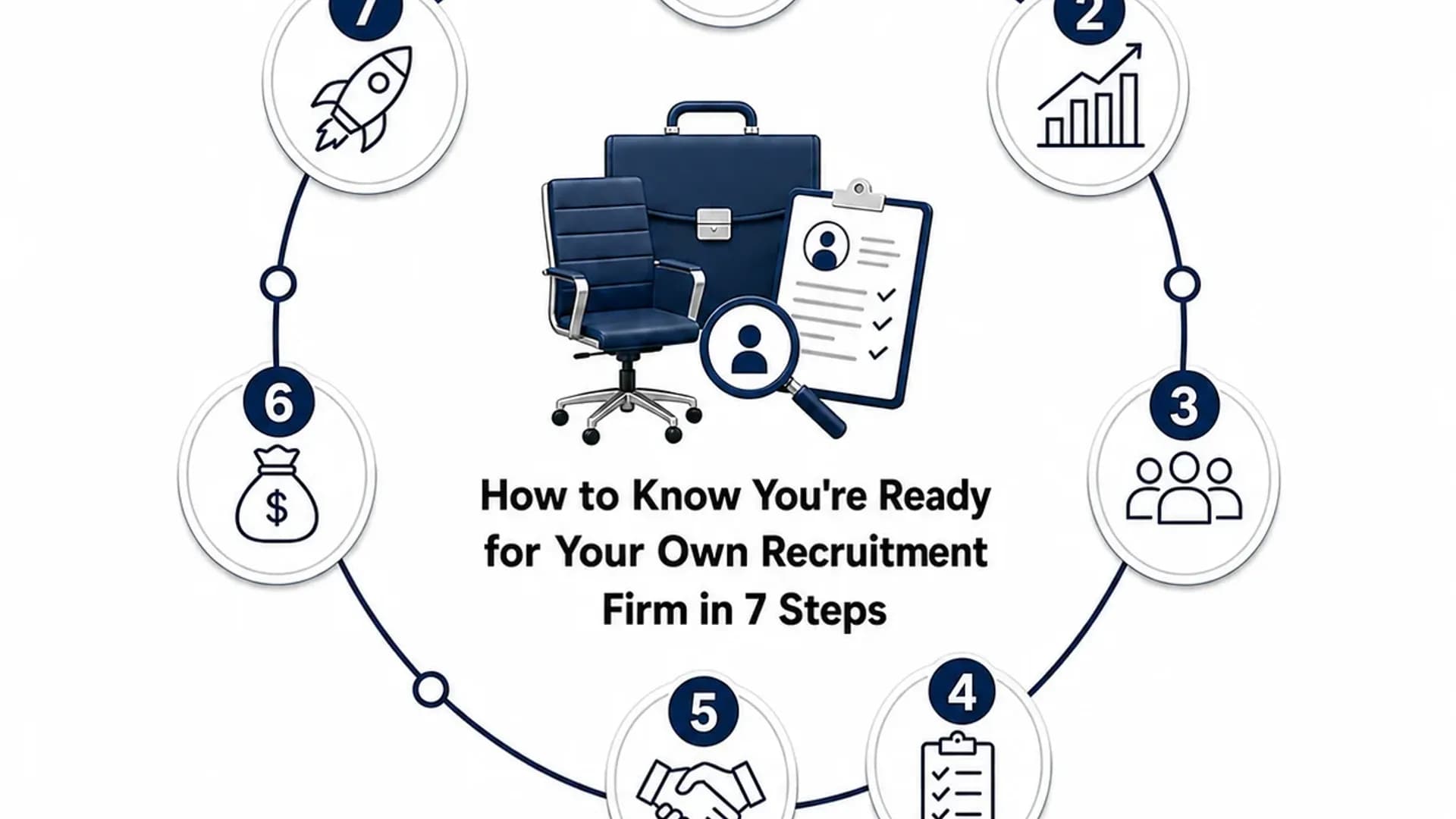
Quick Guide: How to Know You're Ready for a Recruitment Firm in 7 Easy Steps
- Assess your recruitment track record and niche expertise: Confirm you have consistent billings, a defined niche, and 360-degree capability.
- Evaluate your financial runway and personal commitments: Calculate how many months of living expenses you can cover without income.
- Map your client and candidate network strength: Identify the contacts who will realistically follow you to a new firm.
- Review your legal and compliance knowledge: Check your understanding of Companies House, HMRC obligations, and data protection.
- Audit your operational readiness and support needs: Decide which back-office functions you will outsource and which you will handle.
- Test your personal resilience and motivation: Be honest about your tolerance for uncertainty, isolation, and ownership demands.
- Build your launch timeline and accountability plan: Set a go-live date with milestones. SSG Recruitment Partnerships provides a structured launch timeline from day one.
How to Assess Your Readiness Before Launching a Recruitment Firm
1. Assess your recruitment track record and niche expertise
Your billing history is the clearest indicator of launch readiness. If you have been consistently placing candidates in a specific sector for two or more years, you already have the market knowledge and client credibility that a new firm depends on.
Focus on whether you have operated as a 360-degree recruiter. This means you have sourced your own clients, won job briefs, identified candidates, and managed the full placement process. Recruiters who have only resourced or only managed accounts often find that gap becomes a serious obstacle in the first few months of independence.
Define the niche you plan to operate in. A clearly defined vertical, whether that is IT contracting, healthcare, or construction, gives you a positioning advantage and makes it easier to win early business against generalist competitors.
2. Evaluate your financial runway and personal commitments
The gap between leaving paid employment and collecting your first placement fee is the period most new founders underestimate. In permanent recruitment, you may wait 60 to 90 days or longer before a fee lands in your account. For temporary and contract desks, cash flow pressure can be even more acute because you pay workers weekly while clients settle invoices on 30 to 60 day terms.
Calculate your essential monthly outgoings, including mortgage or rent, utilities, insurance, and any dependants' costs. Then work out how many months you can sustain yourself without income. A minimum of three to six months of personal runway is a common benchmark, though the exact figure depends on your circumstances.
3. Map your client and candidate network strength
Your professional network is the single most valuable asset you will carry into a new business. But there is a difference between knowing people and having people who will place trust in a brand-new agency.
Start by listing the hiring managers, HR directors, and procurement contacts you have placed with in the last 12 months. Of those, how many have a personal relationship with you rather than with your current employer's brand? Those are the contacts most likely to give your new firm a chance.
On the candidate side, identify the professionals who come to you directly rather than responding to job adverts. A strong candidate following suggests that your reputation and sector expertise carry weight independently of your current agency.
Be realistic about restrictive covenants in your current contract. Most employment agreements include non-compete or non-solicitation clauses that limit which clients and candidates you can approach for a defined period after leaving. Review these terms carefully, ideally with legal advice, before you plan your first-month business development activity.
4. Review your legal and compliance knowledge
Running your own recruitment firm means personal responsibility for a range of legal and regulatory obligations. You need to register your company with Companies House, set up PAYE and VAT registration with HMRC, register with the Information Commissioner's Office for data protection, and ensure your contracts comply with employment law.
If you plan to place temporary or contract workers, additional considerations apply. You will need to understand IR35 legislation, CIS registration for construction roles, and right-to-work checks under UK immigration rules. The penalties for getting these wrong are significant.
You do not need to become a legal expert overnight, but you do need to know what you do not know. Many successful founders work with specialist partners who handle HR and legal compliance on their behalf, which allows them to stay focused on recruitment without risking regulatory missteps.
5. Audit your operational readiness and support needs
Beyond recruiting, you will be responsible for accounting, payroll, invoicing, credit control, marketing, IT systems, and general business administration. That is a long list, and it pulls your time away from the revenue-generating activity your business depends on.
Conduct an honest self-audit. Which of those functions can you handle confidently? Which ones would you be learning from scratch? For most recruitment entrepreneurs, the answer is that accounting and payroll require specialist expertise, while credit control and marketing are often underestimated time sinks.
Decide early whether you will build these capabilities in-house or outsource them to a strategic partner. SSG Recruitment Partnerships handles accounting, payroll, credit control, marketing, legal, and technology setup for its partners so that recruitment entrepreneurs can focus entirely on winning business and finding talent for their clients.
6. Test your personal resilience and motivation
The transition from employment to business ownership is as much a psychological shift as it is a financial one. In your current role, you have colleagues, a manager, an established brand, and a steady salary. All of that disappears on day one of your own firm.
Ask yourself these questions honestly. Can you handle weeks or months of low revenue without losing confidence? Are you comfortable making decisions alone, from pricing your services to choosing a CRM platform? Do you have support outside of work, whether that is a partner, family member, or mentor, who understands what you are taking on?
Impostor syndrome is common among first-time founders, even experienced billers. Joining a community of recruitment business owners who have navigated the same transition can reduce isolation and give you a sounding board for the challenges that come with the territory.
7. Build your launch timeline and accountability plan
Once you have completed the six readiness checks above, you need a structured timeline that turns your decision into action. A realistic launch plan covers company registration, brand development, technology setup, marketing preparation, and your first 90 days of business development activity.
Set a firm go-live date and work backwards from it. Assign milestones to each week, including legal setup, CRM configuration, website launch, and your first outreach campaign. Without a timeline, the gap between "ready" and "live" can stretch into months of inaction.
SSG Recruitment Partnerships supports partners through a structured launch process that takes as little as four weeks from initial conversation to going live. Your company, brand, website, systems, and back-office support are set up in parallel so you can focus on building pipeline from the start.
What skills do you need before launching a recruitment agency?
The core skill set for a successful recruitment agency founder goes beyond placing candidates. You need strong business development ability, which means generating new client relationships through networking, direct outreach, and referrals rather than relying on inbound enquiries.
Financial literacy matters more than most new founders expect. You should be able to read a basic profit and loss statement, understand your gross margin per placement, and forecast your cash flow over a rolling 90-day period. These skills help you make informed decisions about when to invest in growth and when to tighten spending.
Communication and negotiation are daily requirements, both with clients and candidates. You will negotiate fees, manage expectations on timelines and shortlists, and handle difficult conversations when placements fall through.
According to the TC Group Recruitment Benchmarking Report 2025, well-run recruitment firms outperformed the broader market even during a challenging year, which underlines the importance of combining recruitment skill with solid business fundamentals from the start.
How much does it cost to start a recruitment firm?
The startup costs for a UK recruitment agency vary depending on your model. A home-based, permanent-only agency can launch with minimal outlay if you already own a laptop, a phone, and a LinkedIn Recruiter licence. Your main costs will be company registration, professional indemnity insurance, a CRM subscription, and initial marketing materials.
For temporary or contract desks, the cash requirement increases significantly. You will need working capital to cover contractor pay before client invoices are settled. This gap can amount to thousands of pounds per month, even with a small number of active placements.
Partnership models offer an alternative to self-funding. SSG Recruitment Partnerships invests in its partners from day one, covering setup costs and providing credit control, payroll, and technology infrastructure at no upfront cost. This approach means you can launch without depleting personal savings or taking on business debt.
How SSG Recruitment Partnerships helps you launch your own recruitment firm
SSG Recruitment Partnerships removes the operational barriers that hold experienced recruiters back from going independent. With more than 21 years in the industry and over 500 businesses launched across perm, temp, and contract sectors, SSG has built the infrastructure that de-risks your transition from employed recruiter to business owner.
When you partner with SSG, you receive funding from day one, a bespoke brand and website, a full technology stack including CRM and VoIP, and comprehensive partner support covering accounting, payroll, HR, legal, and marketing. Partners retain 100% equity in their business and benefit from a dedicated Partner Support Manager who provides strategic advice and growth planning.
Partners are 2.9 times more likely to succeed than founders who launch alone, and the average first-year income reported by SSG partners exceeds £200,000. That track record reflects the depth of operational, financial, and strategic support available from the moment you decide to go independent.
Ready to assess your readiness? Book a no-obligation conversation with SSG and find out how quickly you could be live and billing.
FAQs about starting your own recruitment firm
How long does it take to start a recruitment agency?
The timeline depends on how much infrastructure you need to set up. Company registration with Companies House takes 24 to 48 hours, but building your brand, configuring technology, and preparing contracts can take several weeks. SSG Recruitment Partnerships gets partners from conversation to live billing in as little as four weeks.
Can I start a recruitment agency from home?
Yes. A home-based setup is one of the most common and cost-effective ways to launch. You need a reliable internet connection, a professional phone system, and a CRM to manage your pipeline. Many SSG partners operate from home offices and scale into serviced or permanent office space as their business grows.
Do I need recruitment experience to start my own firm?
Recruitment experience is strongly recommended. Founders who have worked as 360-degree consultants and built their own client relationships have the highest success rates. The operational side of running a business can be learned or outsourced, but sector knowledge and placement skills are difficult to replicate without hands-on experience.
What is the biggest risk when launching a recruitment business?
Cash flow is the most common reason new recruitment firms fail. The gap between paying contractors or covering personal expenses and receiving your first placement fee can stretch to three months or longer. SSG Recruitment Partnerships addresses this directly by providing salary support and funding from day one, so partners can focus on billing rather than survival.
How do I know if I have enough clients to launch?
A useful benchmark is whether you can identify at least three to five hiring managers who would seriously consider working with you under a new brand. You do not need confirmed job orders, but you do need genuine relationships and a niche where you are recognised as a trusted adviser. SSG Recruitment Partnerships helps partners validate their market positioning before they go live.